A mini-workshop in and around motives.
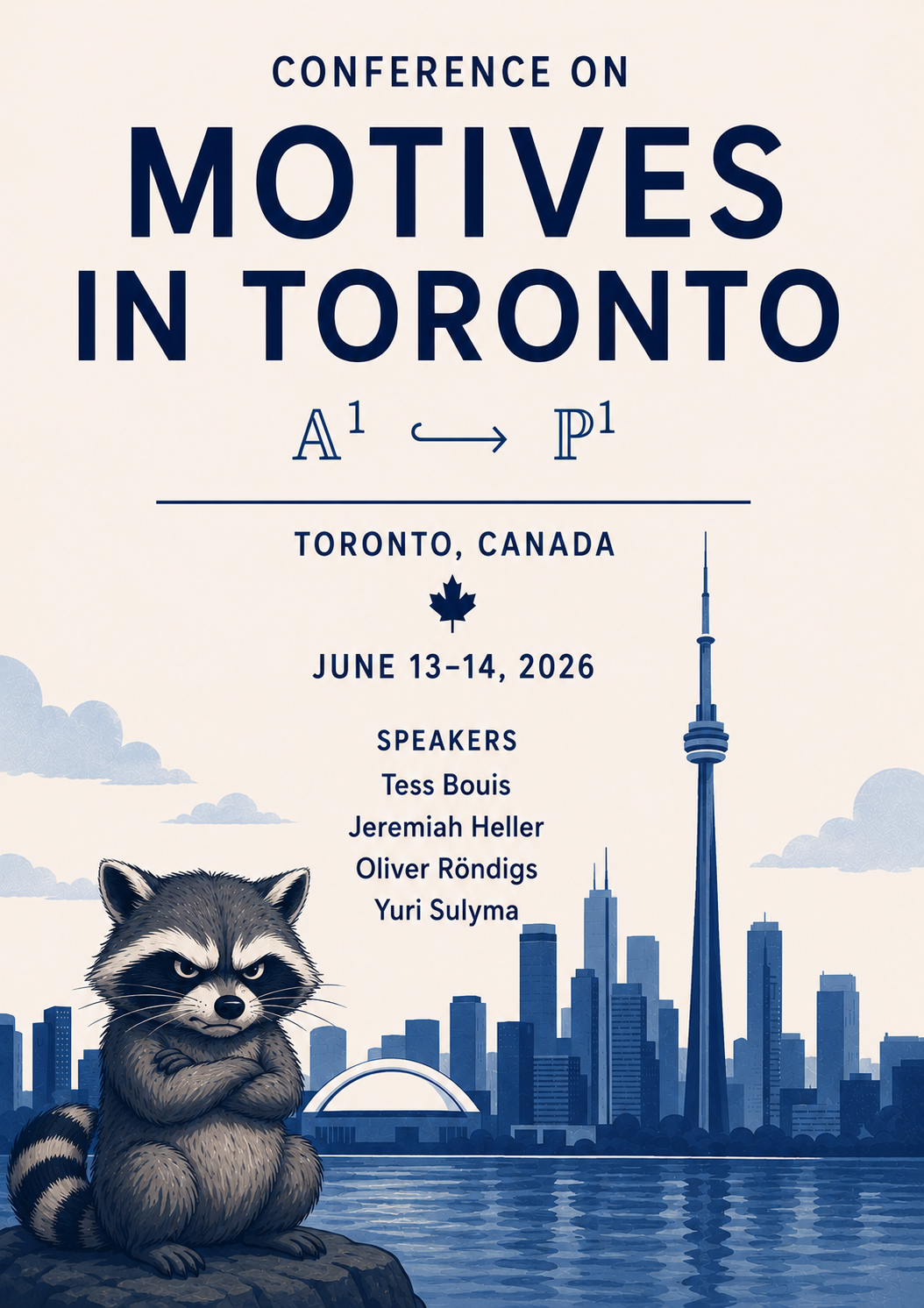
Speakers
- Tess Bouis (Institute for Advanced Study)
- Jeremiah Heller (University of Illinois Urbana-Champaign)
- Oliver Röndigs (Osnabrück)
- Yuri Sulyma (Liqvid)
Schedule
Saturday (13th June 2026)
930-10am Aravind Asok (special talk)
10-11am Oliver
11-12pm Jeremiah
12-2pm Lunch break
2-3pm Oliver
3-4pm Yuri
5pm – ? happy hour + dinner!
Sunday (14th June 2026)
10-11am Tess
3-4pm Jeremiah
12-2pm Lunch break
2-3pm Tess
3-4pm Yuri
Location
Bahen Center, 40 St. George St. Room 6183.
Contact Elden for access to the building.
Abstract
On resolution of singularities and differential forms (Bouis)
Abstract: Before Hironaka’s proof of resolution of singularities, valuation rings were of central importance in Zariski’s program to prove resolution of singularities in characteristic zero. Long after Zariski’s program was abandoned, valuation rings have more recently been widely used in motivic homotopy theory (via Suslin and Voevodsky’s cdh topology) and in p-adic geometry (motivated in part by Scholze’s perfectoid theory). In these talks, I will discuss my favorite open conjecture on valuation rings and its relations with both motivic homotopy theory and p-adic geometry.
Comparing equivariant stable stems (Heller)
Abstract: Theorems of Levine and Gheorghe-Isaksen determine a region of the motivic stable stems on which Betti realization is an isomorphism. Allen-Piessevaux recently introduced a category of equivariant synthetic spectra for a finite abelian group. An interesting consequence of their work is the existence of maps \tau_V, for each representation V in the category of equivariant motivic spectra, which are equivariant versions of \tau. I’ll explain how to determine a region of the representation graded \mu_p-equivariant motivic stable stems. As a consequence, we obtain an alternate method of discovering Allen-Piessevaux’s \tau_V as well as interesting divisibility relations between the various \tau_V. I’ll also discuss multiplicative properties of the C\tau_V.
Vector bundles on SL_3 (Röndigs)
Consider the special linear group SL_n over a field. Murthy proved that every vector bundle over SL_2 is trivial. Swan constructed a nontrivial vector bundle of rank two over SL_4 for the field of complex numbers. This led Nakamoto and Torii to investigate vector bundles over SL_3, and to conjecture that they are all trivial. I will discuss this conjecture using unstable A1-homotopy theory.
RO(G)-graded norms for de Rham-Witt forms (Sulyma)
A foundational computation in the field of trace methods is Hesselholt’s theorem: the TR^n of smooth algebras over a perfectoid base is given by the de Rham-Witt complex tensored with a polynomial generator in degree 2. But TR^n is naturally graded over the representation ring of Z/p^n. Angeltveit-Gerhardt gave an algorithm to compute the RO(G)-graded TR^n of perfect F_p-algebras as modules. Revisiting their work, I will explain an RO(G)-graded generalization of Hesselholt’s theorem: we compute the RO(G)-graded TR of smooth algebras over a perfectoid base, in closed form, as an RO(G)-graded Tambara functor (at least in a large range). As an application, we generalize Angeltveit’s norm map of Witt vectors to the de Rham-Witt complex.

